The "S" Makes the Difference: Why Screening-Led is the New Standard.
Traditional BTAM is waiting for a fight to break out. SBTAM is finding the student before they ever get mad enough to fight.


The Proactive Gap
Most school safety models are reactive by design. They rely on negative behavior: a student making a threat, a peer reporting a social media post, or an administrator witnessing a fight.
The Problem: Research shows that waiting for a report results in a near 0% identification rate of at-risk students before a crisis occurs.
The Solution: SBTAM. By leading with universal screening, we identify the internalizing risk factors (hopelessness, withdrawal) and externalizing triggers (aggression, weapon access) that preceded a threat.

Built on Four Pillars
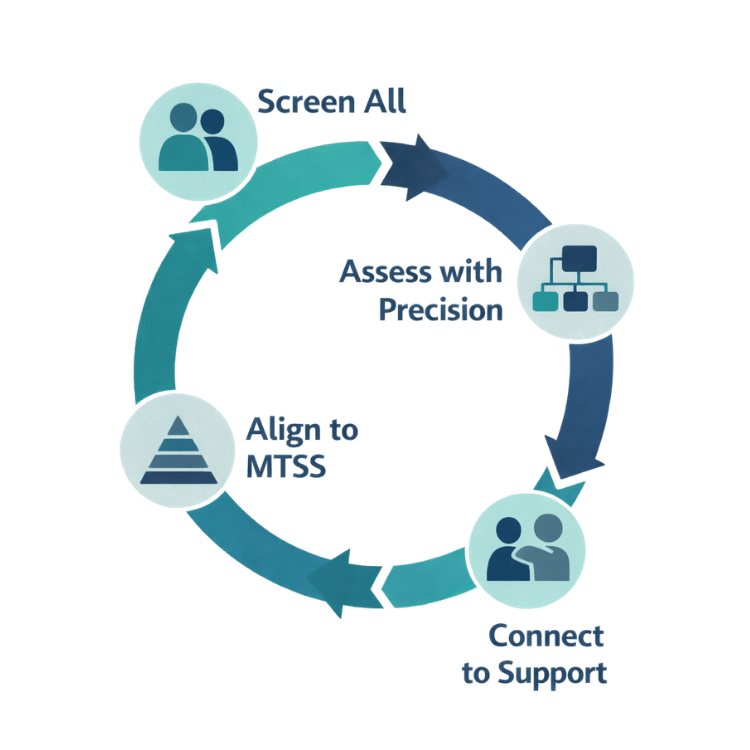
A brief screener for the many. A deep-dive for the few. Adaptive branching logic provides targeted assessment only where critical indicators demand it.
We don’t guess. We ask every student. Universal screening ensures that no student is invisible—including those who suffer in silence.
Pillar 1: Universal Screening
Pillar 2: Adaptive Precision
Pillar 3: Support Centric
The goal isn’t to punish behavior. It’s to connect students to the help they need. SBTAM shifts the conversation from discipline to social-emotional support.
Pillar 4: MTSS Aligned
Screening data plugs directly into your existing Tier 1, 2, and 3 intervention frameworks. No parallel systems. No data silos.
The Data-Driven Case for being Screening-Led
Most schools rely on "referral-based" safety. If a student isn't disruptive, they aren't on the radar. However, research into the SBTAM framework shows a startling reality:
The Status Quo: Referral-only systems often result in a 0% identification rate of at-risk students before a crisis.
The SBTAM Advantage: Implementing a universal, screener-led model increases the identification of at-risk students to 22%—catching nearly a quarter of the student body that would have otherwise suffered in silence.
Speed to Service: Because the data is immediate, 59% of identified students are connected to professional services within just seven days of screening.


+22%
increase in identification rate of at-risk students who need help
More than a Safety Check: A Whole-Child View
Measuring aggression, conflict, and exposure to weapon-related talk.
Identifying the "quiet" symptoms of depression, anxiety, and hopelessness.
Internalizing Risk
Externalizing Risk
Social Isolation
Flagging students who are withdrawing from or avoiding school.
Peer Dynamics
Identifying both the victims and perpetrators of violent acts at school.
Protective Factors
Measuring school belonging and access to trusted adults—the strongest "brakes" against violent behavior.
The SBTAM framework doesn't just look for "threats." It looks for the root causes of behavior. Our core 25-item FOCUS screener captures five critical dimensions of the student experience:
Where Mental Health Meets School Safety
The greatest failure of traditional BTAM is the silo between "Counseling" and "Security." SBTAM breaks those silos down:
Social-Emotional Insight
Investigative Rigor
The Result
We use clinical-grade screening logic (SRA) to manage self-harm and mental health crises.
For students flagged with violent propensity, our framework integrates NTAC (National Threat Assessment Center) investigative questions to help teams assess credibility and intent.
A multidisciplinary team that speaks the same language, using the same data, to create one unified safety plan.

Don't wait for the next discipline referral. Lead with data.
Are you ready to move your district from reactive investigation to Screener-Led Behavior Threat Assessment and Management?
Contact
Reach out for support or questions
Subscribe to our SChool Safety Newsletter
info@sbtam.com
© 2026 SBTAM.com. All rights reserved.
The Screening-Led Behavioral Threat Assessment & Management (SBTAM) Framework was developed by Dr. Steven Hornyak and is protected by copyright. The framework concept, methodology, and associated written materials may not be reproduced, adapted, or distributed without express written permission. For licensing, speaking, or partnership inquiries, contact info@sbtam.com.