The Research Behind SBTAM
SBTAM is not a theory. It is a framework built on a converging body of evidence from behavioral health screening, threat assessment, MTSS implementation, and educational equity research. The key findings that shaped this framework are summarized below.
The Identification Gap Is Real
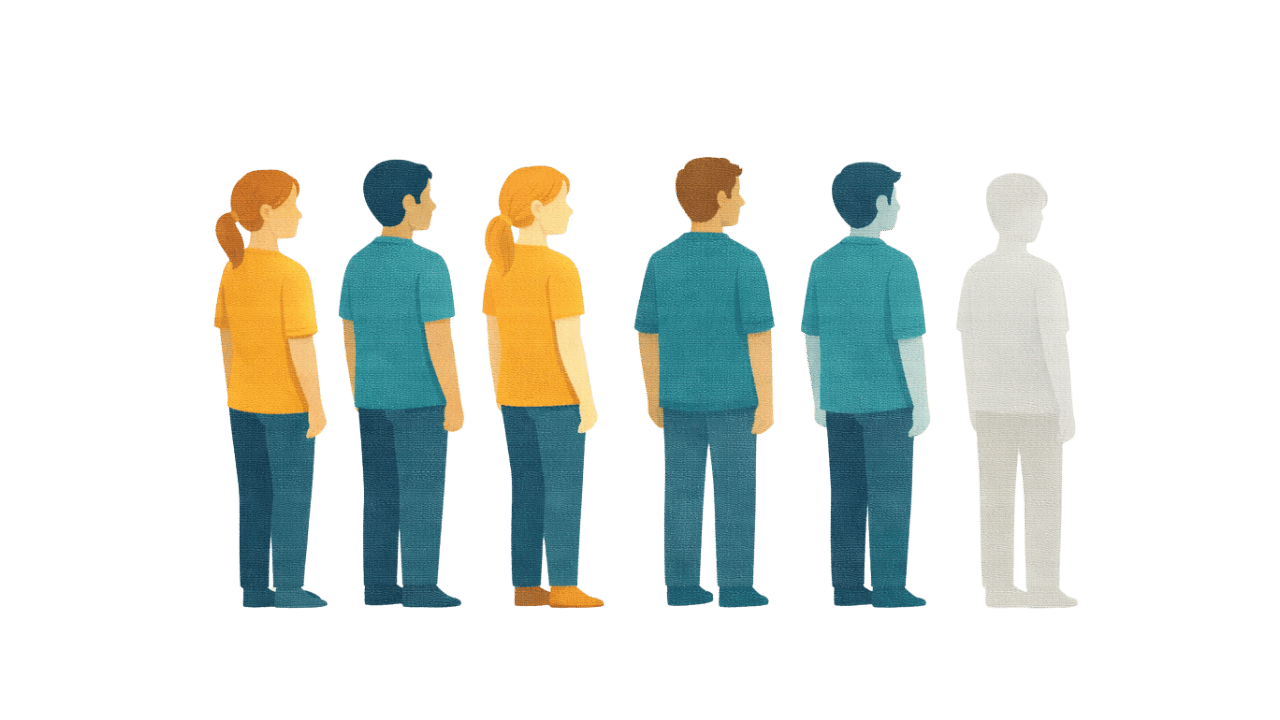
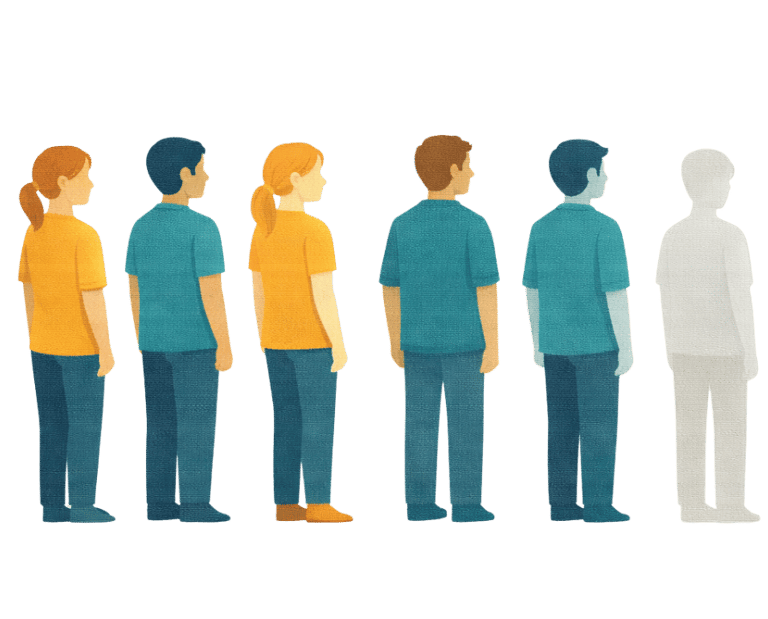
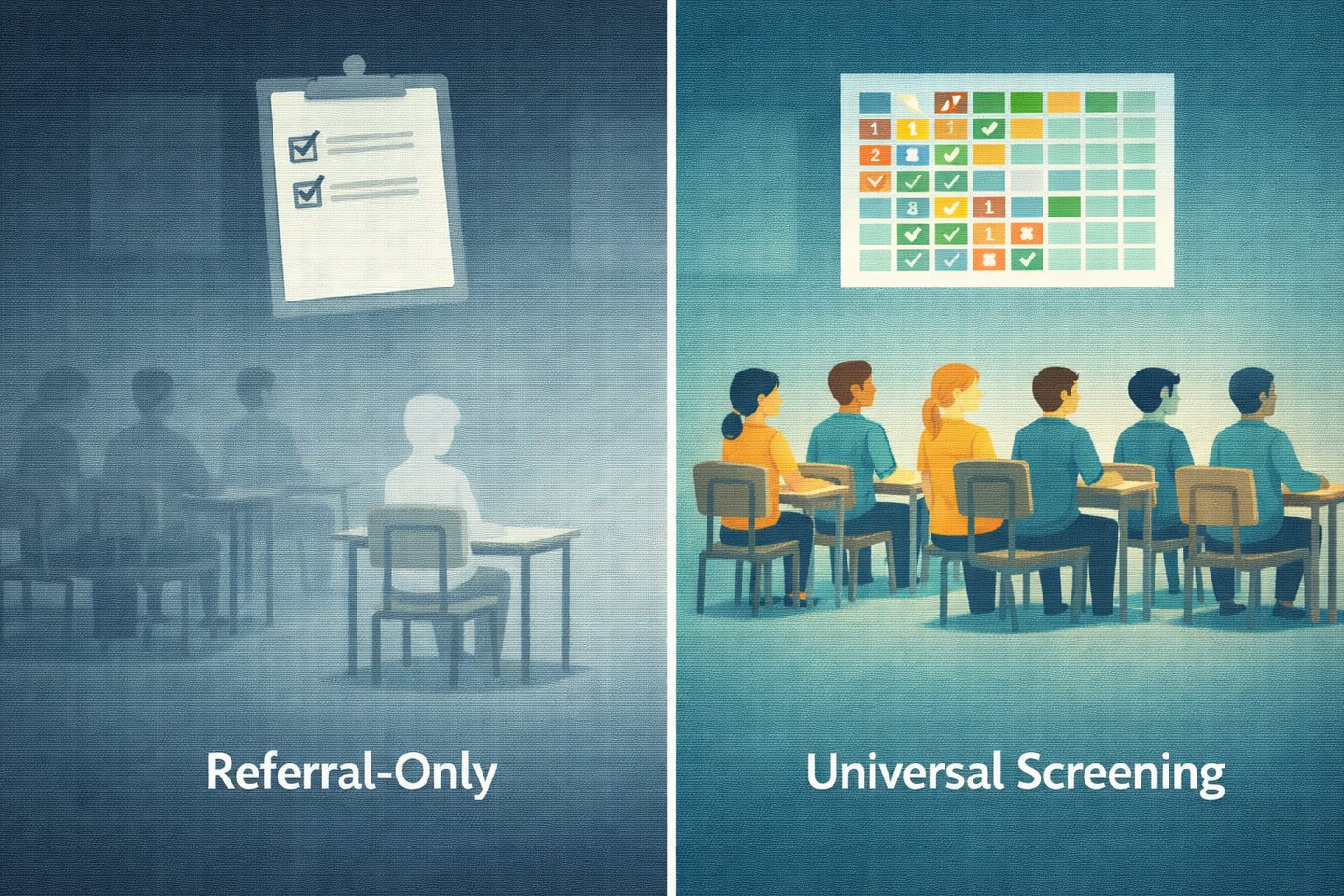
Decades of research confirm what practitioners already know: the students who most need help are the least likely to be referred. Studies consistently show that students with internalizing problems: depression, anxiety, withdrawal, quiet rage, are difficult for teachers to identify because these behaviors are not disruptive and don't register as problems requiring referral. A landmark study by Pearcy, Clopton, and Pope (1993) found that teachers are significantly less likely to refer students for internalizing concerns than for externalizing ones, and that gender compounds this effect: girls with depression are among the least-referred populations of all. This structural blind spot is not a failure of individual teachers. It is a predictable flaw in any system that depends on observation and referral to trigger a response.
Referral Systems Carry Systemic Bias
Traditional BTAM is referral-dependent, and referral systems carry well-documented racial, gender, and disability-based disparities. A 2025 Cornell University study examining over 15,000 threat assessments across 1,221 schools found measurable disparities in threat assessment referral rates across student grade, gender, race/ethnicity, and disability status, with students with disabilities comprising 41% of all threat assessments despite being a minority of the population. Existing data indicates that Black students are disproportionately referred for threat assessments, and that students with disabilities are substantially more likely to be referred than other students. When systems rely on adult observation and judgment as the primary data source, implicit bias is not an edge case: it is embedded in the architecture of the system itself. Universal self-report screening bypasses this vulnerability by going directly to the student.
Most At-Risk Students Are Never Identified
Research has shown that many school-aged children with or displaying characteristics of a mental health disorder go unidentified and untreated. As recently as 2019, nearly every principal surveyed in a large statewide study reported that their school did not conduct universal mental health screening, with lack of access to screeners and insufficient funding cited as the primary barriers. The National Research Council and Institute of Medicine identified a window of opportunity lasting two to four years between a student's first symptom and the emergence of a full-blown disorder, a window when preventive intervention is most effective. Without systematic universal screening, that window closes unseen.
Universal Screening Changes the Identification Rate
Research consistently shows that when universal behavioral health screening is implemented, approximately 13-21% of students can be expected to fall within an at-risk group, with 5-11% presenting concerns significant enough to require immediate follow-up. That is a dramatically different outcome than the near-zero early identification rates typical of referral-only systems. Studies using the Behavioral and Emotional Screening System found that students at mild to moderate risk often show academic performance similar to peers, meaning academic data alone will not surface them. Universal screening is the only reliable mechanism for early identification of this population.
Self-Report Is the Right Instrument for Adolescents
FOCUS uses self-report format intentionally, not by default. Research indicates that as students age, their responses on self-report screeners become more useful and accurate. Older students have greater insight into their own internalizing states than teachers or parents, making student self-report the most valid source of data for identifying adolescent behavioral health risk. Teacher-completed screeners are more reliable for externalizing behaviors that disrupt classrooms, the very students who would have been referred anyway. Self-report closes the gap on the students no one would have flagged.


The MTSS Connection Is Not Optional — It's Structural
Strong empirical evidence supports MTSS implementation, with high-quality adoption associated with improvements in prosocial behavior, reductions in problem behaviors, and decreases in mental health difficulties. SBTAM does not create a parallel system, it feeds into the one districts already operate. Screening data generates actionable intelligence at every tier: school-wide trends inform Tier 1, cluster patterns drive Tier 2 group interventions, and individual critical-item flags generate Tier 3 referrals. No new infrastructure required.
Early Intervention Is More Effective and Less Costly
Research demonstrates that early identification of student risk through universal screening supports a more systematic, proactive approach to services and supports within an MTSS framework, and that early intervention is less costly to schools than long-term or intensive care. Waiting for a crisis is not just dangerous. It is expensive.
References
The following sources support the Research Foundation of the SBTAM framework.
The Identification Gap Is Real
Pearcy, M. T., Clopton, J. R., & Pope, A. W. (1993). Influences on teacher referral of children to mental health services: Gender, severity, and internalizing versus externalizing problems. Journal of Emotional and Behavioral Disorders, 1(3), 165–169. https://doi.org/10.1177/106342669300100304
Green, M. T., Clopton, J. R., & Pope, A. W. (1996). Understanding gender differences in referral of children to mental health services. Journal of Emotional and Behavioral Disorders, 4(3), 182–190. https://doi.org/10.1177/106342669600400305
Splett, J. W., Garzona, M., Gibson, N., Wojtalewicz, D., Raborn, A., & Reinke, W. M. (2019). Teacher recognition, concern, and referral of children's internalizing and externalizing behavior problems. School Mental Health, 11(2), 228–239. https://doi.org/10.1007/s12310-018-09303-z
Siceloff, E. R., Bradley, W. J., & Flory, K. (2017). Universal behavioral/emotional health screening in schools: Overview and feasibility. Report on Emotional & Behavioral Disorders in Youth, 17(1), 5–13. https://pmc.ncbi.nlm.nih.gov/articles/PMC6350819/
Referral Systems Carry Systemic Bias
Cornell, D. G., Kerere, J., Konold, T., Maeng, J., Afolabi, K., Huang, F., & Cowley, D. (2025). Referral rates for school threat assessment. Psychology in the Schools, 62(1), 1–12. https://doi.org/10.1002/pits.23399
End Zero Tolerance. (2020, March 29). The risks of threat assessment to students are dire. https://www.endzerotolerance.org/single-post/2020/03/29/the-risks-of-threat-assessment-to-students-are-dire
American Psychological Association. (2020). Racism and bias: Their role in maintaining racial disparities in PreK–12 education. https://www.apa.org/about/policy/racial-disparities-taskforce-report.pdf
Parker, M., Ostrander, A., Decker, E., & Ray, S. (2023). Teachers' referral practices: Opportunities for school counselor advocacy. Journal of School-Based Counseling Policy and Evaluation, 5(2), 58–71. https://files.eric.ed.gov/fulltext/EJ1412012.pdf
Most At-Risk Students Are Never Identified
Wood, B. J., & McDaniel, T. (2020). A preliminary investigation of universal mental health screening practices in schools. Children and Youth Services Review, 112, Article 104943. https://doi.org/10.1016/j.childyouth.2020.104943
Bruhn, A. L., Woods-Groves, S., & Huddle, S. (2014). A preliminary investigation of emotional and behavioral screening practices in K–12 schools. Education and Treatment of Children, 37(4), 611–634. https://doi.org/10.1353/etc.2014.0039
Romer, D., & McIntosh, M. (2005). The roles and perspectives of school mental health professionals in promoting adolescent mental health. In D. Evans, E. Foa, R. Gur, H. Hendin, C. O'Brien, M. Seligman, & B. Walsh (Eds.), Treating and preventing adolescent mental health disorders: What we know and what we don't know (pp. 598–615). Oxford University Press.
National Research Council & Institute of Medicine. (2009). Preventing mental, emotional, and behavioral disorders among young people: Progress and possibilities. National Academies Press. https://doi.org/10.17226/12480
Universal Screening Changes the Identification Rate
Burns, M. K., & Rapee, R. M. (2021). From barriers to implementation: Advancing universal mental health screening in schools. Journal of Psychologists and Counsellors in Schools, 31(2), 246–258. https://doi.org/10.1017/jgc.2021.17
Splett, J. W., Garzona, M., Gibson, N., Wojtalewicz, D., Raborn, A., & Reinke, W. M. (2019). Teacher recognition, concern, and referral of children's internalizing and externalizing behavior problems. School Mental Health, 11(2), 228–239. https://doi.org/10.1007/s12310-018-09303-z
Connors, E. H., Moffa, K., Splett, J. W., Lever, N., & Weist, M. D. (2022). Advancing mental health screening in schools: Innovative, field-tested practices and observed trends during a 15-month learning collaborative. Psychology in the Schools, 59(6), 1135–1157. https://doi.org/10.1002/pits.22670
Wood, B. J., Nellis, L. M., & colleagues. (2022). Universal mental health screening practices in Midwestern schools: A window of opportunity for school psychologist leadership and role expansion? Contemporary School Psychology, 27, 287–299. https://doi.org/10.1007/s40688-022-00430-8
Self-Report Is the Right Instrument for Adolescents
California Behavioral Health Services Oversight and Accountability Commission. (2022). Universal mental health screening of children and youth: Phase 1 literature review. https://bhsoac.ca.gov/wp-content/uploads/MHSOAC_UMHS-Phase-1-Report-Lit-Review_Final.pdf
O'Malley, M. D. (2020). Self-report screening in school-based mental health: Considerations for adolescents. In D. Romer, E. A. Kutcher, & R. Comer (Eds.), Screening for behavioral health risk in schools. SAMHSA.
Kettler, R. J., Albers, C. A., & colleagues. (2017). Universal screening for behavioral and emotional risk. Journal of Applied School Psychology, 33(3), 195–214.
Dowdy, E., Ritchey, K., & Kamphaus, R. W. (2010). School-based screening: A population-based approach to inform and monitor children's mental health needs. School Mental Health, 2(4), 166–176. https://doi.org/10.1007/s12310-010-9036-3
Early Intervention Is More Effective and Less Costly
Kuo, E., Vander Stoep, A., McCauley, E., & Kernic, M. A. (2009). Cost-effectiveness of a school-based emotional health screening program. Journal of School Health, 79(6), 277–285. https://doi.org/10.1111/j.1746-1561.2009.00410.x
Vander Stoep, A., Weiss, N. S., Kuo, E. S., Cheney, D., & Cohen, P. (2003). What proportion of failure to complete secondary school in the US population is attributable to adolescent psychiatric disorder? Journal of Behavioral Health Services & Research, 30(1), 119–124. https://doi.org/10.1007/BF02287817
Humphrey, N., & Wigelsworth, M. (2016). Making the case for universal school-based mental health screening. Emotional and Behavioural Difficulties, 21(1), 22–42. https://doi.org/10.1080/13632752.2015.1120051
The MTSS Connection Is Not Optional — It's Structural
Bradshaw, C. P., Waasdorp, T. E., & Leaf, P. J. (2012). Effects of school-wide positive behavioral interventions and supports on child behavior problems. Pediatrics, 130(5), e1136–e1145. https://doi.org/10.1542/peds.2012-0243
Splett, J. W., Weist, M. D., Bruns, E., Gottlieb, M., Nabors, L., & George, M. W. (2019). The interconnected systems framework for school mental health: Advancing the academic and social-emotional outcomes of students. School Psychology, 34(5), 487–498. https://doi.org/10.1037/spq0000311
California Behavioral Health Services Oversight and Accountability Commission. (2022). Universal mental health screening of children and youth: Phase 1 literature review. https://bhsoac.ca.gov/wp-content/uploads/MHSOAC_UMHS-Phase-1-Report-Lit-Review_Final.pdf
Dowdy, E., Ritchey, K., & Kamphaus, R. W. (2010). School-based screening: A population-based approach to inform and monitor children's mental health needs. School Mental Health, 2(4), 166–176. https://doi.org/10.1007/s12310-010-9036-3
Vander Stoep, A., Cheney, D., & Kuo, E. (2003). Universal emotional health screening at the middle school transition. Journal of Emotional and Behavioral Disorders, 11(2), 100–109. https://doi.org/10.1177/10634266030110020201
Contact
Reach out for support or questions
Subscribe to our SChool Safety Newsletter
info@sbtam.com
© 2026 SBTAM.com. All rights reserved.
The Screening-Led Behavioral Threat Assessment & Management (SBTAM) Framework was developed by Dr. Steven Hornyak and is protected by copyright. The framework concept, methodology, and associated written materials may not be reproduced, adapted, or distributed without express written permission. For licensing, speaking, or partnership inquiries, contact info@sbtam.com.