School Safety Starts Before the Threat
Most schools wait for a student to make a threat before they act. SBTAM identifies the risk factors—hopelessness, aggression, and isolation—while they are still manageable.
The Identification Gap
Traditional Behavioral Threat Assessment and Management (BTAM) is referral-based. The process starts when someone reports a concern—a teacher notices alarming behavior, a peer reports a threat, or a student engages in violent behavior.
The problem? Most at-risk students never get referred at all.
Students with internalizing risk factors—depression, hopelessness, suicidal ideation, quiet rage—don’t disrupt class. They don’t get sent to the office. They sit in the back row and suffer in silence until something breaks.
Research shows that referral-based systems identify 0% of at-risk students before a crisis event. SBTAM was built to change that number.


The Proactive Shift
SBTAM—Screening-Led Behavioral Threat Assessment & Management—adds a proactive data layer to existing BTAM infrastructure. Instead of waiting for a phone call, your safety team receives objective, student-reported data that identifies who needs help—including the students nobody would have referred.


SBTAM (Screening-Led)
Traditional BTAM
Referral-based: Someone must “see something, say something.”
Only reaches students who act out or get reported.
Subject to referral bias based on race, gender, and behavior type.
Reactive: Responds after a threat or event.
0% identification before crisis.
Universal screening identifies risk automatically.
100% of students checked 2–3 times per year.
Objective self-report data directly from the student.
Proactive: Identifies risk before it manifests as a threat.
Up to 22% early identification; 59% connected to services in 7 days.
0% → 22%
Early identification rate with universal screening vs. referral-only systems.
59%
10 minutes
Of identified students connected to support services within 7 days.
Average screening time. 90% of students finish the core screener in under 10 minutes.
Built on Four Pillars
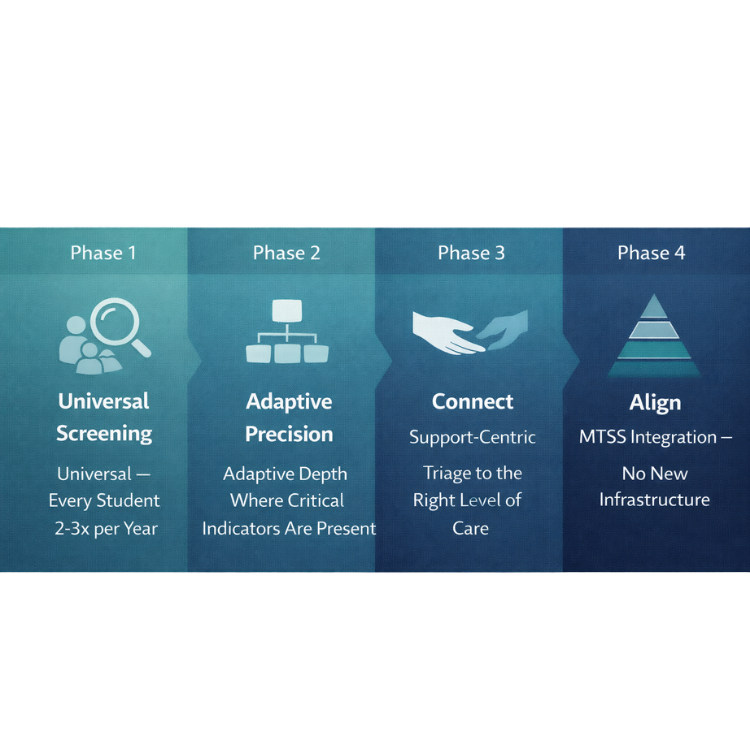
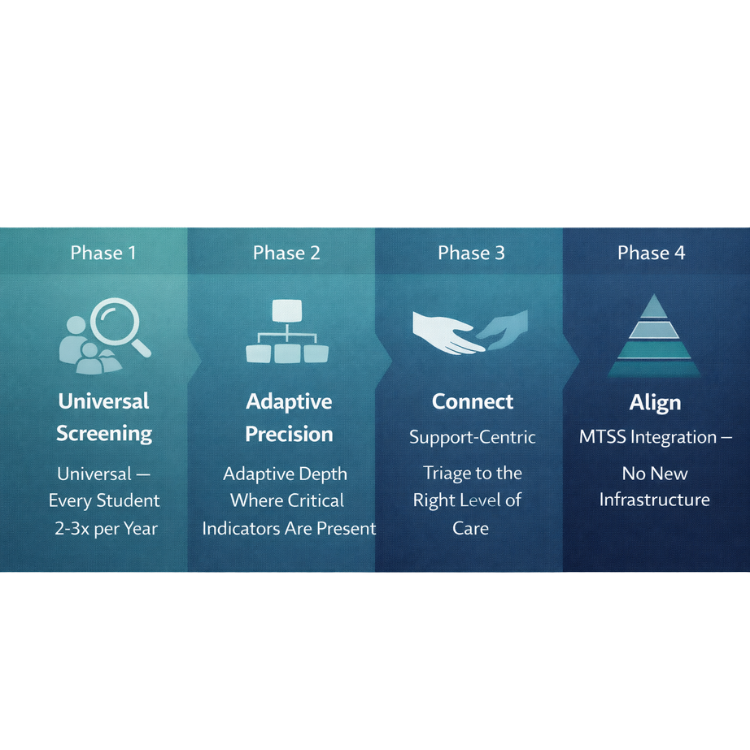
A brief screener for the many. A deep-dive for the few. Adaptive branching logic provides targeted assessment only where critical indicators demand it.
We don’t guess. We ask every student. Universal screening ensures that no student is invisible—including those who suffer in silence.
Pillar 1: Universal Screening
Pillar 2: Adaptive Precision
Pillar 3: Support Centric
The goal isn’t to punish behavior. It’s to connect students to the help they need. SBTAM shifts the conversation from discipline to social-emotional support.
Pillar 4: MTSS Aligned
Screening data plugs directly into your existing Tier 1, 2, and 3 intervention frameworks. No parallel systems. No data silos.
Powered by FOCUS
The FOCUS (Factors of Concern, Understanding, and Safety) screener is the data engine behind the SBTAM framework. Built specifically for grades 6–12, FOCUS combines efficient universal screening with adaptive depth where it matters most.
• 25-Item Core Screener: Covers emotional and behavioral concerns, aggression, withdrawal, bullying, and school climate.
• Adaptive Branching: Critical-item responses automatically trigger targeted assessments for self-harm risk (SRA) and behavior threats (BTA).
• Self-Report Format: Students share their own experiences directly, reducing the referral bias inherent in adult-only observation models.
• Immediate Triage: High-risk results route instantly to the appropriate support personnel—counselors, BTAM teams, or crisis staff.



Developed by an Educator, for Educators
The SBTAM framework and the FOCUS Universal Adaptive Screener were developed by Dr. Steven Hornyak, an 18-year veteran of public education who has served as both a classroom teacher and district-level administrator. As a Chief Innovation Officer, Steven has led initiatives in behavioral screening, social-emotional learning, assessment development, and AI integration—all centered on one question: How do we find every student who needs help, before it’s too late?
SBTAM is grounded in research, shaped by practice, and driven by a belief that every student deserves to be seen, not just the ones who act out.


Georgia Districts: Meet HB 268 Head on
Georgia’s House Bill 268 requires every public school district to implement BTAM teams, behavioral health screening, and suicide and violence prevention training for grades 6–12 by July 2026. SBTAM and the FOCUS screener were built to meet these mandates—not as an afterthought, but as the foundation of your compliance plan.



Stop waiting for the threat. Start managing the risk.
Traditional BTAM tells you what to do after a threat. SBTAM tells you who to help so the threat never happens.
Contact
Reach out for support or questions
Subscribe to our SChool Safety Newsletter
info@sbtam.com
© 2026 SBTAM.com. All rights reserved.
The Screening-Led Behavioral Threat Assessment & Management (SBTAM) Framework was developed by Dr. Steven Hornyak and is protected by copyright. The framework concept, methodology, and associated written materials may not be reproduced, adapted, or distributed without express written permission. For licensing, speaking, or partnership inquiries, contact info@sbtam.com.